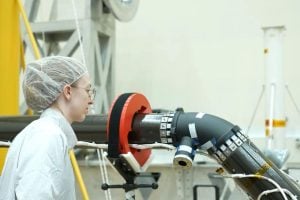
Gina Ghiglieri is pursuing her master’s degree in mechanical engineering through the Engineering for Professionals program. An additive manufacturing product manager by day and an online student by night, Ghiglieri is completing her degree while maintaining a full-time job.
“The flexible nature of the courses offers great flexibility with my schedule,” she says. “I attend office hours and have the ability to do projects related to my work, and my company also pays for part of it, which is really awesome.”
The Engineering for Professionals programs came recommended by colleagues at her company, Lanteris Space Systems, an Intuitive Machines Company, who fabricates satellites and space systems. “That’s what prompted me to start looking. I got my undergraduate degree in aerospace engineering, but I do a lot of materials and mechanical engineering in my job, so there were some gaps in my knowledge,” she says. “Undergrad was a good foundation, but there was more highly specific knowledge that I wanted to attain. The EP curriculum is fabulous for that.”
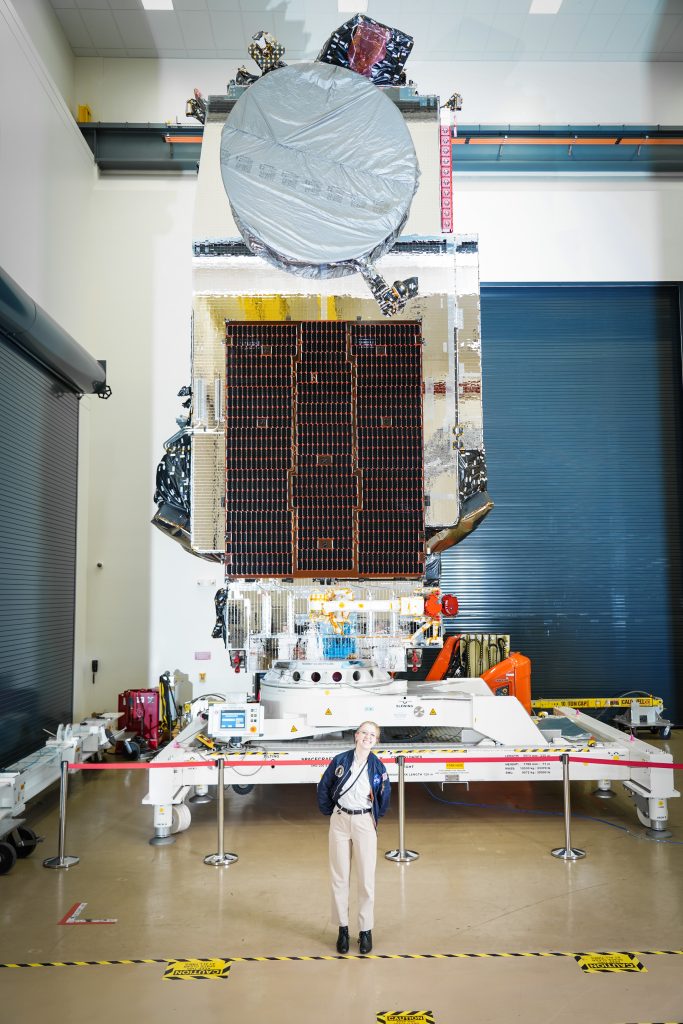
Gina Ghiglieri standing in front of the final assembly of the Jupiter 3 satellite
She liked being able to choose what courses she’d take to tailor her experience around what she wanted to learn for her career. “Every course has felt incredibly relevant to what I’m doing for my job. I will learn something, and then a week or two later, I’ll notice something at work that’s applicable to what I just learned,” she says. “And I think working in industry and then going back to school has been good for me. I needed that industry experience to set up another foundation where I can contextualize the things I’m learning about in my courses.”
She took Modern Polymeric Materials (535.684) with Zhiyong Xia, and for her final project, she evaluated additively manufactured high-temperature, electrostatically dissipative polymers for thermal covers for deployable mechanisms, such as thrusters or reflector booms. The 3D-printed plastics for parts such as brackets and covers typically replace machined or injection-molded polymers.
“I was able to 3D print some parts, then do some testing in-house at our Lanteris Space Systems Reliability Physics Laboratory in Palo Alto, and then write a report and publicly share it,” she explains. “If I had just done a normal material evaluation for my job, I only would have checked certain boxes and might not have gotten the deeper understanding out of it. So having the unique combination of both studying research-related topics, while also being able to apply it to my actual job, was very beneficial,” she says. “I got so much out of just that one course.”
Her current work in ultra-high-temperature materials made watching the Artemis mission feel a little closer to home. “I have a little more insight into what’s going on with the heat shield and all these other considerations for space flight,” she says, “and having teachers who also worked in the industry through NASA or the Johns Hopkins Applied Physics Laboratory has been really beneficial.”
Part of her job is evaluating opportunities to utilize 3D printing—or additive manufacturing—which is not just limited to plastic. Her company does metal 3D printing that begins as a powder. Then a laser or a beam of electrons can melt and fuse material layer by layer to arrive at a certain shape. A 2024 article she wrote explains more.
“We can make some unique components that are optimized for flight and save weight which is a massive consideration when you’re making spacecraft. And this is how we can save material costs as well. You don’t have to machine away a bunch of material to get your final part,” she explains. “You just put material where it’s needed and build it up from there. Most of my job is educating people on this stuff, because it is a relatively new technology that even engineers within the industry are not as familiar with.”
“I’m contextualizing everything now to a much greater degree and deepening my understanding,” she says, “but I also like thinking of new questions, and my degree is making me more curious about how I think about the world.” Ghiglieri plans to complete her degree in 2027.
Photos courtesy of Gina Ghiglieri