Master’s in Applied Biomedical Engineering Program Overview
In the Johns Hopkins Engineering Applied Biomedical Engineering online, part-time master’s program, you will study with acclaimed experts in biomedical research and medical care who are spearheading the latest techniques in practice and research. From using physiological knowledge and mathematical methods to design lab experiments and equipment to developing biological system modeling and computer simulation, you will take a deeper dive into the science and engineering that impacts the health of humanity.
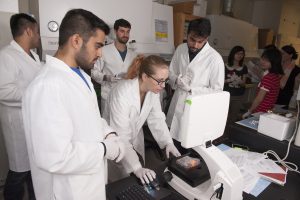
You will also work alongside our colleagues who are scientists, physicians, and engineers at the world-renowned Johns Hopkins Hospital during a unique hybrid two-weekend residency course in Baltimore. Dynamic and life-saving solutions evolve from these biomedical engineering course projects, including a student who redesigned the Ebola protective suit by integrating a cooling system. In this hands-on, immersive lab experience, you will also design and build your own EKG monitor.
Take your biomedical engineering career to the next level with this unique interdisciplinary online, part-time master’s program that will allow you to:
- Gain high demand skills to advance in the biomedical industry
- Apply engineering principles to solve physiological and medical challenges
- Design laboratory experiments and equipment
- Engineer innovative solutions to unmet clinical needs
- Translate cutting edge biomedical research into technologies of the future
- Learn on your terms and enjoy a flexible course schedule in a format that works best for you
Applied Biomedical Engineering Master’s Degree Focus Areas
A focus area must be selected.
Artificial Intelligence in Medicine: Students in this focus area will master the application of artificial intelligence, machine learning, and related computational techniques to medical problems. They gain expertise in developing AI-driven tools for diagnosis, treatment planning, predictive analytics, brain-computer interfaces, and improving healthcare outcomes while addressing ethical and practical considerations in clinical settings. View focus area requirements
Biomechanics: Develop the skills to model and analyze mechanical function in biological systems, from cellular forces to human movement. Students in this focus area will learn to apply engineering principles to advance our understanding and design of biological and medical systems. View focus area requirements
Biomedical Data Science: This focus area equips students with the skills to analyze, model, and derive insights from large-scale biomedical datasets. Students learn statistical methods, data analytics, computational modeling, and bioinformatics techniques to uncover patterns in health data, support precision medicine, and advance computational approaches to biological and clinical challenges. View focus area requirements
Clinical Engineering: Focusing on the integration of engineering principles with healthcare systems and patient care, this focus area emphasizes the application of technology in clinical environments. Students develop expertise in rehabilitation engineering, healthcare systems design, global health technologies, regulatory considerations, and the safe implementation and management of medical solutions in real-world clinical settings. View focus area requirements
Imaging: Students in this focus area will explore the principles and technologies behind biomedical imaging and image processing. Gain expertise in developing, analyzing, and applying imaging systems for medical diagnosis and research. View focus area requirements
Medical Devices: This focus area emphasizes the design, development, and evaluation of biomedical sensors and instruments. Students will learn how to translate engineering concepts into safe, effective medical technologies for clinical use. View focus area requirements
Neuroengineering: Focusing on the interface between engineering and neuroscience, this focus area examines how to sense, model, and influence neural systems. Students will develop tools for applications such as neural prosthetics, brain–computer interfaces, neuroimaging, and diagnostics. View focus area requirements
Translational Tissue Engineering: This focus area integrates biology and engineering to design and develop functional tissues and regenerative therapies. Students gain the foundation to move engineered tissue solutions from research to clinical application. View focus area requirements
Programs
We offer three program options for Applied Biomedical Engineering: you can graduate with a Master of Science in Biomedical Engineering degree or a post-master's or graduate certificate.

Applied Biomedical Engineering Courses
See course requirements, prerequisites, focus areas, and electives offered within the program. For exact dates, times, locations, fees, and instructors, please refer to the course schedule published each term.
Program Contacts
-
 Email:ehaase1@jhu.edu
-
 Email:brock.wester@jhuapl.edu
-
Email:Andrew.Marshall@jhuapl.edu
-
Email:inolan1@jhu.edu
Tuition and Fees
Did you know that 78% of our enrolled students’ tuition is covered by employer contribution programs? Find out more about the cost of tuition for prerequisite and program courses and the Dean’s Fellowship.
Why Hopkins?
Apply engineering principles to shape the future of the biomedical industry.

Study with faculty who are practicing scientists and notable professionals with corporations and government entities, including the Johns Hopkins Applied Physics Lab, NASA, Raytheon, and the U.S. Department of Defense. Exceptional one-on-one mentoring sets you on a course to be a confident, knowledgeable leader.

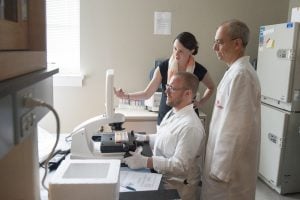
Hands-On Experience - Get access to specialized lab opportunities offered at the Johns Hopkins Hospital and the university’s state-of-the-art laboratories on our main Homewood campus.
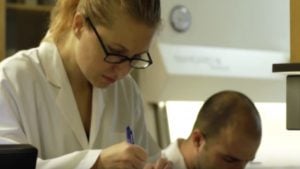
Biomedical Engineering Practice and Innovation - This hybrid residency course is an integral part of the Applied Biomedical Engineering program curriculum, and it covers experimental and design work primarily in the areas of physiology, cell and tissue engineering, and biomedical instrumentation.
“Our Applied Biomedical Engineering program combines rigorous academic instruction with immersive, hands-on learning experiences. Through flexible online learning, hybrid laboratories, virtual reality environments, and take-home experimental kits, students actively collect, analyze, and interpret their own experimental data. ”
Academic Calendar
Find out when registration opens, classes start, transcript deadlines and more. Applications are accepted year-round, so you can apply any time.
-


Cancer has a sweet tooth—and that craving might be more revealing than scientists once thought.
-

Johns Hopkins Awarded $15M to Develop Platform to Study Neurological Diseases, Screen Chemicals
CategoriesResearchers will join a new NIH-supported network working to develop novel approach methodologies that complement or replace animal testing
-

EP's Leslie Hamilton part of Microcapsule AI-driven Testing, Learning, and Accelerated Synthesis (ATLAS) project
Applied Biomedical Engineering FAQ's
A: Biomedical Engineering is an interdisciplinary field, and those who complete a master’s program find careers that span a variety of specialties. Some become artificial tissue engineers, while others design and test technologically advanced medical devices. Our career advisors are available throughout your education experience to guide you, answer questions, and help you find your exact career path.
A: Many graduates who hold a Master’s in Applied Biomedical Engineering earn 13% to 30% more than their bachelor’s degree peers. Additionally, completing a master’s degree course gives you unprecedented access to specialized, high-demand skills and knowledge, as well as robust networking opportunities.
A: Yes. If your prior education does not include the engineering background prerequisites, you may still be admitted on a provisional basis and then granted full admission once you have completed the missing prerequisites with Johns Hopkins Engineering or at another regionally accredited institution.
A:The average salary for a professional with a Master’s in Biomedical Engineering in the U.S. is approximately $94,000 to $107,000 per year in early 2026 Source: US Bureau of Labor Statistics
Applied Biomedical Engineering Master’s Student Outcomes
An Applied Biomedical Engineering master's degree can help you build the technical expertise needed to contribute to innovations that improve patient care, healthcare delivery, and medical technology. As healthcare organizations, medical device manufacturers, and biotechnology companies continue investing in advanced technologies, professionals with interdisciplinary engineering and life sciences knowledge are increasingly sought after.
Whether you're seeking to advance within the healthcare technology sector or transition into a biomedical engineering career from another engineering discipline, graduate education can help you develop the specialized capabilities that align with industry needs. Many students also benefit from networking opportunities that connect them with healthcare professionals, researchers, engineers, and industry leaders.
Applied Biomedical Engineering integrates engineering principles with biological and medical sciences to address complex healthcare challenges. Through a biomedical engineering master’s program, you’ll develop advanced knowledge and skills in medical device design, biomedical instrumentation, biomaterials, physiology, imaging technologies, and healthcare systems engineering.
Students often strengthen their ability to analyze biological systems and evaluate how engineering solutions can improve diagnosis, treatment, and patient outcomes. Coursework typically emphasizes data analysis, computational modeling, signal processing, and regulatory considerations that influence healthcare technology development.
Project management and interdisciplinary collaboration are particularly important soft skills for biomedical engineers because professionals frequently work alongside physicians, researchers, regulatory specialists, and product development teams. Understanding how to communicate across disciplines helps ensure that medical technologies meet both clinical and technical requirements.
These skills are necessary because healthcare technologies must operate safely, effectively, and in compliance with complex regulatory standards. Engineers who understand both technical design principles and healthcare applications are better equipped to develop solutions that address real-world medical challenges.
Graduate education can also help you stay informed about emerging technologies and establish professional relationships that support long-term career growth in a rapidly evolving industry.
Graduates of biomedical engineering master’s programs pursue a variety of technical, research, and product-focused careers. Common positions include biomedical engineer, medical device engineer, clinical engineer, quality engineer, regulatory affairs specialist, product development engineer, and research engineer.
Some professionals focus on medical imaging systems, diagnostic technologies, rehabilitation devices, wearable health technologies, or biomaterials research. Others move into leadership positions overseeing product development, quality assurance, or engineering operations within healthcare organizations.
According to the U.S. Bureau of Labor Statistics, biomedical engineers earned a median annual salary of $110,380 in May 2024. Employment is projected to grow 7% from 2024 to 2034, faster than the average for all occupations. The BLS attributes continued demand to advances in medical technology and the healthcare industry’s ongoing need for innovative solutions.
For professionals seeking career advancement, an Applied Biomedical Engineering master’s degree can help demonstrate specialized expertise while opening opportunities in both technical and management-oriented roles.
Applied Biomedical Engineering graduates work across a diverse range of healthcare and technology sectors. Medical device manufacturing remains one of the largest employment areas, with organizations developing products that support diagnosis, treatment, monitoring, and rehabilitation.
Biotechnology companies employ biomedical engineers to contribute to research, product development, and process improvement initiatives. Healthcare systems and hospitals also hire professionals to evaluate, maintain, and optimize clinical technologies used in patient care.
There are also career opportunities within pharmaceutical organizations, healthcare consulting firms, government agencies, contract research organizations, and academic research institutions. Emerging fields such as digital health, telemedicine, wearable technologies, and precision medicine continue to create new opportunities for professionals with advanced biomedical engineering knowledge.
As healthcare technologies become increasingly sophisticated, graduates with strong technical knowledge and skills may be well-positioned to pursue leadership opportunities, contribute to innovation efforts, and support the development of technologies that improve patient outcomes and healthcare delivery.